
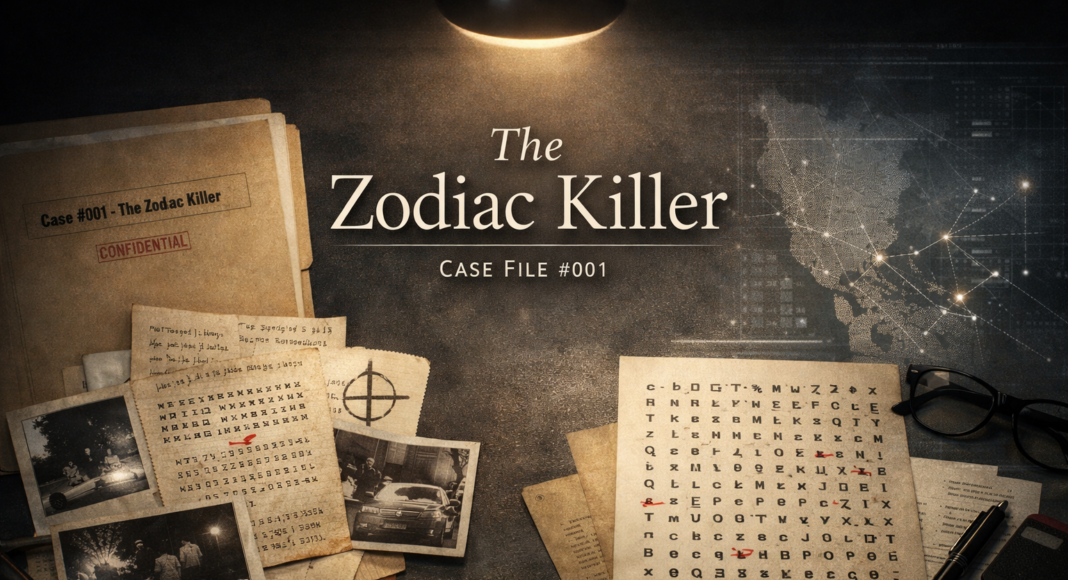
Field Notes – 001 – The Zodiac Killer

Reading Time: 10 minutes
Categories: , , ,
Alibis & Algorithms · Season 1 · Field Notes

Before the Algorithm

The Zodiac Killer: confirmed timeline, crime scene dossiers, victim profiles, all four ciphers, and the media machine that made a murderer immortal — before AI entered the picture.

Editorial Notice — This Field Notes brief covers confirmed historical events drawn from law enforcement documentation, verified academic sources, and court records. No accusations are made against any individual, living or deceased. The Zodiac Killer case remains officially open — FBI San Francisco Division.

Visual 1 Case File Zero-One — Series Masthead
Alibis and Algorithms — Before the Algorithm, Case File Zero-One
Visual 2 Case Statistics — By the Numbers
Zodiac Killer case statistics infographic
Five confirmed dead. Seven total attacked. Four ciphers sent. Fifty-one years before a single coded message yielded its text.
5
Confirmed Killed
7
Total Attacked
4
Ciphers Sent
51
Years Z340 Unsolved
Visual 3 Series Pull Quote
He didn't just kill. He performed — and he expected an audience.

This Field Notes brief is your forensic architecture for the Zodiac Killer case: a confirmed timeline, crime scene dossiers for each attack, victim profiles, cipher breakdowns, and a media amplification analysis tracing how a local murder became a national obsession. It closes with a primer for the next episode on ciphers and AI.

Part 1 — The Confirmed Timeline

The Zodiac’s confirmed criminal activity spans ten months in 1969, followed by five years of letters. Every event in the graphic below is confirmed and documented. The anchors are fixed. Everything else remains disputed.

Visual 4 Confirmed Event Timeline — December 1968 to December 2020
Zodiac Killer confirmed event timeline
Red nodes = attacks. Blue = correspondence. Gold = hoax event. Green = the 2020 Z340 solve.
◆ Analyst Note

The timeline is deceptively simple. Four attacks in ten months, then letters for five more years. The physical violence stopped. The communication never did. That asymmetry — brief violence, extended theater — is the defining behavioral signature of this case.

Part 2 — Crime Scene Dossiers

Each confirmed attack is documented below as a formal case dossier: forensic specifics, known physical evidence, and behavioral analysis. Behavioral observations are drawn from criminological literature and investigative record. They are observations, not conclusions.

Incident Report · Case File 01

Lake Herman Road

Gravel turnout, Benicia (Solano County) · December 20, 1968 · Approx. 11:05–11:10 PM
Victims
David Faraday, 17 · Betty Lou Jensen, 16
Casualties
Jensen: dead at scene, 5 gunshot wounds in back. Faraday: died en route, single shot to the head.
Weapon
.22 caliber semi-automatic · Winchester Western Super X · 10 casings recovered
Evidence
No usable fingerprints. No tire impressions. No witnesses to the attack itself.
Behavioral Analysis

The killer parked alongside the victims and waited. A critical detail: 45 minutes of surveillance before the attack. He watched them first. This was not rage. This was patience.

Incident Report · Case File 02

Blue Rock Springs Park

Vallejo · July 4–5, 1969 · Approx. 12:05 AM
Victims
Darlene Ferrin, 22 · Michael Mageau, 19 [SURVIVED]
Casualties
Ferrin: died at Kaiser Foundation Hospital. Mageau: survived wounds to leg, neck, and jaw.
Weapon
9mm semi-automatic pistol (different from Case File 01 weapon)
Evidence
Killer phoned Vallejo PD 40 minutes after the attack, claiming credit for both this attack and Lake Herman Road — the first explicit link between the two crimes.
Behavioral Analysis

He left, then came back. The pause before the return volley suggests a need to confirm control. The phone call claiming credit is the single most ego-driven act in the case up to this point. He built his own evidence trail.

“He left. He came back. Then he called the police to make sure they knew it was him.”

Incident Report · Case File 03

Lake Berryessa

Twin Oak Ridge, Napa County · September 27, 1969 · Approx. 6:00–6:45 PM
Victims
Cecelia Shepard, 22 [DIED Sep 29] · Bryan Hartnell, 20 [SURVIVED]
Casualties
Shepard: 10 stab wounds; died two days later. Hartnell: 6 stab wounds; survived; gave the most complete physical description in the entire case.
Weapon
Foot-long blade. Firearm present but not discharged.
Costume
Handmade black hood with crosshair symbol stitched on chest. Described as “machine-made” by Hartnell. Pre-cut rope brought to scene.
Evidence
Wet palm print — never matched. Writing left on car door. Killer drove 27 miles to call the Napa Sheriff from a payphone near the department.
Behavioral Analysis

The most prepared attack in the case: handmade costume, pre-cut rope, rehearsed cover story, planned exit. He retied Hartnell’s hands because Shepard’s knots were too loose. He talked to both victims for several minutes before stabbing them. This was not impulsive.

Incident Report · Case File 04

Presidio Heights

Washington St & Cherry St, San Francisco · October 11, 1969 · Approx. 9:55–10:10 PM
Victim
Paul Stine, 29 — cab driver, San Francisco State philosophy graduate student
Casualties
Stine: died at scene, single shot to the head. Three teenage witnesses directly across the street.
Weapon
9mm semi-automatic — ballistically distinct from the Case File 02 weapon.
Dispatch Error
Radio call incorrectly broadcast suspect as a Black male. Officers drove past a white male matching witnesses’ description exactly.
Evidence
Bloody fingerprints recovered. Killer tore a piece of Stine’s shirt — mailed portions to the Chronicle as proof for years afterward.
Behavioral Analysis

Moving from rural lovers’ lanes to an urban taxi murder signals escalating confidence, desperation, or both. Four attacks, four separate jurisdictions: Solano County, Vallejo PD, Napa County, SFPD. That geographic fragmentation was not accidental.

◆ Analyst Note

A consistent thread across all four attacks: the Zodiac communicated after every one. Phone calls, letters, physical evidence mailed to newsrooms. He needed the record to reflect what he had done. Every attack was also a press release.

Part 3 — The Victims

Five people were killed. Two survived. None had any prior known relationship to their attacker. They were teenagers, young adults, a waitress, a music student, and a philosophy grad student — found at a lovers’ lane, a park, a lake, and a cab. What connected them was only circumstance and his proximity.

Visual 5 Victim Profiles — All Seven People Attacked
Zodiac Killer victim profiles
Red top border = killed. Green top border = survived. Five confirmed dead. Two survived to provide the most complete witness accounts in the case.
✕ Killed · Lake Herman Road
Betty Lou Jensen
Age 16 · Student, Hogan High School
Honor student. Member of Pythian Sunshine Girls. First date with David Faraday.
✕ Killed · Lake Herman Road
David Faraday
Age 17 · Student, Vallejo High School
Senior. Had promised Betty Lou’s parents he would have her home by 11 PM.
✕ Killed · Blue Rock Springs
Darlene Ferrin
Age 22 · Waitress, Vallejo
Lived two blocks from Betty Lou Jensen’s family. Appeared to know she was being followed that night.
✓ Survived · Blue Rock Springs
Michael Mageau
Age 19 · Friend of Darlene Ferrin
Shot in the leg, neck, and jaw. Survived. Provided one of the most detailed early attacker descriptions.
✕ Killed · Lake Berryessa
Cecelia Shepard
Age 22 · Music student, Pacific Union College
Gave a detailed attacker description while still conscious, then lapsed into a coma before reaching the hospital.
✓ Survived · Lake Berryessa
Bryan Hartnell
Age 20 · Student, Pacific Union College
Asked to be stabbed first. Survived six wounds. Gave investigators the most complete physical description in the entire case.
✕ Killed · Presidio Heights
Paul Stine
Age 29 · Cab driver & philosophy grad student, SFSU
Working weekend night shifts to pay tuition. No known connection to the case or any other victim.
In Record

The Zodiac’s mythology cast them as slaves destined for his afterlife. Their names deserve to outlast his.

Part 4 — The Four Ciphers

The Zodiac sent four coded messages over the course of his correspondence. They were not decorative — each was a deliberate act of power. He wanted the world to know he was speaking. He wanted it to fail to understand what he was saying.

Visual 6 Cipher Comparison — Z408, Z340, Z13, Z32
The four Zodiac ciphers compared
Z408 solved in 8 days by two civilians. Z340 took 51 years and three amateurs with AI-adjacent tools. Z13 and Z32 remain officially unsolved.
Z408
408 characters
✓ Solved — 1969
Donald & Bettye Harden · 8 days
Homophonic substitution only. Psychological reasoning cracked it faster than pure mathematics — Bettye assumed “kill” would appear early. It did.
Z340
340 characters
✓ Solved — 2020
Oranchak, Blake, Van Eycke · 51 years
Substitution + transposition combined. Message written in a diagonal 1,2-decimation skip pattern. Both layers had to be solved simultaneously.
Z13
13 characters
✗ Officially Unsolved
Preceded by “My name is ____.”
Too short for any solution to be uniquely verified. Every letter of the alphabet can produce a plausible name. Mathematically unfalsifiable.
Z32
32 characters
✗ Officially Unsolved
Sent with a Phillips 66 map of Mt. Diablo
Only 3 of 29 distinct characters repeat. May require external geographic data from the map to decode — data that may be unrecoverable.

The Z340 — Decoded After 51 Years

In December 2020, David Oranchak, Sam Blake, and Jarl Van Eycke cracked the Z340 using Van Eycke’s AZdecrypt hill-climbing solver and Blake’s 650,000 transposition variations generated in Wolfram Mathematica. The FBI confirmed the solution on December 7, 2020.

Visual 7 Z340 Decoded Message
Z340 decoded message graphic
The full decoded text as confirmed by the FBI. No identity revealed. The message did not solve the case.
Z340 · Decoded Text · FBI Confirmed
“I HOPE YOU ARE HAVING LOTS OF FUN IN TRYING TO CATCH ME THAT WASNT ME ON THE TV SHOW WHICH BRINGS UP A POINT ABOUT ME I AM NOT AFRAID OF THE GAS CHAMBER BECAUSE IT WILL SEND ME TO PARADICE ALL THE SOONER BECAUSE I NOW HAVE ENOUGH SLAVES TO WORK FOR ME WHERE EVERYONE ELSE HAS NOTHING WHEN THEY REACH PARADICE SO THEY ARE AFRAID OF DEATH I AM NOT AFRAID BECAUSE I KNOW THAT MY NEW LIFE IS LIFE WILL BE AN EASY ONE IN PARADICE DEATH”
Linguistic fingerprint: The consistent misspelling “PARADICE” (for paradise) appears here and in prior letters — one of the primary markers confirming the authenticity of the 2020 solve. No identity is revealed. The message did not solve the case.
Visual 8 The Breakthrough Team — Oranchak, Blake & Van Eycke
The Z340 solve team
A software developer in Virginia, a mathematician in Melbourne, and a warehouse manager in Belgium — none of them professional cryptographers — solved what the NSA could not.
◆ Analyst Note

David Oranchak on the Z13 and Z32: “Cryptanalysis is all but impossible for such a short ciphertext, because solutions are not guaranteed to be unique, and many thousands have been proposed and generally aren’t scientifically falsifiable.” The Z13 claims an identity. It may always claim nothing verifiable.

Part 5 — Media Amplification

The Zodiac Killer case is one of the earliest documented examples of a criminal deliberately engineering media coverage as part of the crime itself. The media was not a passive observer — it was a mechanism the killer used. The ciphers were hooks. The letters were distribution. In 2026, those mechanisms are exponentially more powerful.

Visual 9 Media Amplification — 5 Phases, 1968 to Present
Zodiac Killer media amplification — 5 phases
From local Vallejo coverage in 1968 to 37 million Netflix households in 2024. The case has never stopped generating news.
1
Local Coverage Only
The Lake Herman Road and Blue Rock Springs murders received only local Benicia and Vallejo coverage. No regional or national pickup. No public link between the two attacks.
2
Demand & Publication
Three newspapers receive three parts of the Z408 with a murder threat. All three complied. The first time a major American newspaper printed content provided directly by an active murder suspect under explicit duress. The story moved to wire services immediately.
3
The Name and the Symbol
“This Is the Zodiac Speaking” gave the media a character. The crosshair gave them a visual. The Z408 decode gave them readable content. Within weeks, coverage shifted from crime reporting to serialized drama. Governor Reagan was briefed. The Bay Area experienced something close to collective panic.
4
The Long Silence
Confirmed killings stopped after October 1969. Letters continued until 1974. Robert Graysmith’s 1986 book Zodiac became the template every subsequent Zodiac media project would follow. David Fincher’s 2007 film made it a genre benchmark.
5
The Digital Age
Oranchak launched ZodiacKillerCiphers.com in 2006. The Z340 solve in 2020 generated global coverage. The Netflix docuseries This Is the Zodiac Speaking reached 37 million households in 2024. In late 2025, an AI-generated claim about the Z13 ran internationally within 48 hours. The combustibility of this case has not diminished since 1969.

“He understood the press cycle of 1969 the way a modern media strategist understands an algorithm. He knew that unsolved, he would never lose the story.”

— Alibis & Algorithms, Season 1 Field Notes
◆ Analyst Note

The Zodiac knew that “print it or face consequences” was a story newspapers couldn’t refuse. He knew a symbol reproduced on every front page becomes a brand. And he knew that unsolved, he would never lose the story. In 2026, the case is still generating headlines. His strategy worked.

▶ Coming Next — The Cipher War

Next Episode: Code, Computation, and the 51-Year Siege

If this was the story, the next episode is the science. The full technical history of each cipher, why the Z340 was exponentially harder than the Z408, and the story of how three citizen codebreakers finally cracked it using AI-adjacent tools.

  • 01If the FBI couldn’t crack the Z340 in 51 years, what specifically did they miss?
  • 02What is the difference between a substitution cipher and a transposition cipher — and why does combining both increase difficulty not additively, but exponentially?
  • 03Why is a 13-character cipher harder to crack than a 340-character one, even with modern computing power?
  • 04What does “hill-climbing algorithm” actually mean in practice — and why was it the right tool when conventional cryptanalysis had repeatedly failed?

References

  1. Oranchak, D., Blake, S., & Van Eycke, J. (2024). The solution of the Zodiac Killer’s 340-character cipher. Cryptologia, 48(2), 129–157. arXiv:2403.17350
  2. Bauer, C. P. (2014). Unsolved!: The history and mystery of the world’s greatest ciphers. Princeton University Press.
  3. Graysmith, R. (1986). Zodiac. St. Martin’s Press.
  4. Federal Bureau of Investigation. (2020, December 11). Statement regarding Zodiac cipher solution. FBI San Francisco Division.
  5. Wolfram Blog. (2021, March 24). The solution of the Zodiac Killer’s 340-character cipher. blog.wolfram.com
  6. Virginia Tech Magazine. (2021). The new cryptographers. eng.vt.edu
author avatar
The Algorithmic Detective

LEAVE A REPLY

Please enter your comment!
Please enter your name here
Captcha verification failed!
CAPTCHA user score failed. Please contact us!

error: Content is protected !!